Important decisions about how to maintain a
lawn area have received a lot of press as ideas change about the ways
we use, and treat, this part of the landscape. Rod Simmons spoke on the
subject recently, and has kindly agreed to share answers to some of the
follow-up questions from his presentation at the symposium; *“Habitat
Conservation Forum: Practices that Sustain Virginia’s Wildlife and
Native Plant Communities.” People will be at different places along the
spectrum for a variety of reasons, but this post contains valuable
insights for all.”
Conservation starts at home, says Rod, first and foremost with:
the importance of not using fertilizers and pesticides
the many benefits of keeping some areas natural and not planting and mulching every square inch of ground
The “Freedom Lawn” I referred to stems in part from Redesigning the American Lawn, by three biologists from Yale University; Herbert Bormann, Diana Balmori, and Gordon Geballe.
I say “in part” because the “lawns” and savannah-like glades I
briefly presented at the symposium require very little maintenance as
opposed to fertilized and chemically treated traditional lawns, but in
contrast are refugia for specialized, mostly native vegetation,
including mosses and lichens, and wildlife that require such conditions
(see photos below). In short, they are high quality, semi-natural areas
vs. the mostly artificial, weedy lawns featured in Redesigning the American Lawn
(reducing or eliminating fossil fuel usage notwithstanding). Moreover,
the native “lawns” offer the appropriate native species and habitat for
pollinators.
Most of these native “lawns” occur in oak (and oak-hickory) overstory
savannahs and glades – places where the forest understory was removed
long ago and maintained as such but were not farmed; hence the native
soils, soil micro-organisms, and seedbank for diminutive native grasses
and wildflowers are retained. This is a common feature throughout
Maryland, D.C., and Virginia.
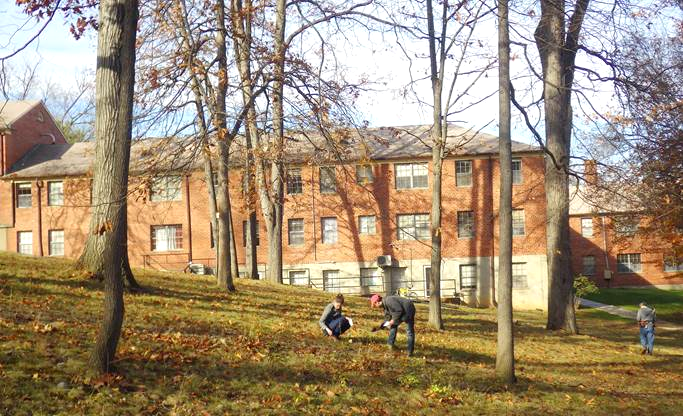
Old-age
Acidic Oak-Hickory Forest grove on south-facing, gravelly colluvial
slope at Barcroft Apartments, Arlington County, VA. Pignut Hickory
(Carya glabra), Sweet Pignut Hickory (Carya ovalis), and Mockernut
Hickory (Carya tomentosa) are all co-dominant canopy trees of the grove.
Poverty Oatgrass (Danthonia spicata), woodland carices (Carex spp.),
and a host of diminutive wildflowers comprise the “no-mow,” low
maintenance, chemical-free turf. Photo by R.H. Simmons.
Negative effects of traditional lawn establishment and maintenance:
Fertilizers, lime, and pesticides destroy most native grasses,
wildflowers, and wildlife, including eventually, the canopy oaks. Apart
from golf courses and athletic fields, they are not necessary and
should never be used. This also includes leaf compost and manure – both
of which are only appropriate for agriculture, gardens, and traditional
lawns, and will disrupt and eventually destroy the balanced, acidic
soils, soil micro-organisms, and flora of woodlands, as well as foster
the growth of non-native invasive plants. Nutrient-loading feeds
pathogens that destroy trees and native biodiversity!
Natural woodland glades and “lawns” should never be over-seeded by commercial grass seed mixes or wildflower seed mixes.
No tilling or soil amendments are recommended – soil disturbance is the main cause of non-native invasive species.
Some ideas for establishing or supplementing native lawns:
Shade (even moderate shade) from canopy trees greatly limits the
growth of most turf grass species, most of which are light-demanding.
The many species and varieties of Red Fescue (Festuca rubra)
are an exception and will grow and persist in shade. However, all
commercially available species and strains of Red Fescue are not native.
If removing existing turf grass in shade is the goal, consider
hand-pulling or shallowly digging out robust clumps or sections of grass
and periodically and carefully applying iron sulfate (never aluminum
sulfate) or elemental sulfur (Garden Sulfur) evenly over the grass
according to the manufacturer’s recommendations. This will gently
acidify the soil and further restrict the growth of turf grass, while
favoring mosses and other woodland plants.
Don’t remove the oak leaves and organic matter (twigs, bark, etc.)
in fall, but shred them up with the lawn mower and leave in place.
(This will require a few passes with the mower to get the leaves to a
small enough size.)
Many of the species native to grassy areas listed below are not
readily available as seed from nurseries. An alternate source for many
of them is responsibly collecting seed material from clean meadowy areas
locally, and supplemented by pots or plugs from specialized native
plant nurseries or rescued material.
Carefully pull or dig non-native weeds.
When one finds open, grassy areas dominated by the species below, it
typically indicates a healthy, diverse, and sustainable community.
Species diversity is typically greater on mafic soils of the Triassic
Basin in the Piedmont vs. acidic, sandy-gravelly soils of the Fall Zone
and Coastal Plain.
Some characteristic native species of oak overstory savannahs and glades are:
Grasses:
Poverty Oatgrass (Danthonia spicata) – dominant and widespread; forms a continuous turf with lots of room for other plants.
Autumn Bentgrass (Agrostis perennans)
Panic Grass (Dichanthelium acuminatum vars.); also Dichanthelium depauperatum, D. dichotomum var. dichotomu D. dichotomumm, and other low Dichanthelia –
not Deer-Tongue Grass (Dichanthelium clandestinum).
Three-awn Grass (Aristida spp.) – mainly in sunny, open areas on mineral soil.
Poverty Grass (Sporobolus vaginiflorus var. vaginiflorus) – mainly in sunny, open areas on mineral soil.
Sedges:
Parasol Sedge (Carex umbellata), Black-edged Sedge (Carex nigromarginata), Reflexed Sedge (Carex retroflexa var. retroflexa), Shaved Sedge (Carex tonsa), and many other low, woodland carices.
Rushes:
Path Rush (Juncus tenuis)
Common
Bluets (Houstonia caerulea), Poverty Oatgrass (Danthonia spicata),
mosses, and woodland litter and duff in open “lawn” along the Mount Ida
escarpment in the City of Alexandria, VA. Photo by R.H. Simmons.
Wildflowers:
Eastern Yellow Stargrass (Hypoxis hirsuta)
Trailing Bush-clover (Lespedeza procumbens); also Creeping Bush-clover (Lespedeza repens) – both prefer some sun.
Pussytoes (Antennaria spp.) – need some sun to bloom well, otherwise it’ll remain non-flowering.
Dwarf-dandelion (Krigia virginica) – in sunny, open areas on mineral soil.
Pinweeds (Lechea spp.) – need some sun to bloom well.
Nailworts (Paronychia canadensis and P. fastigiata)
Pineweed (Hypericum gentianoides) – in sunny, open areas on mineral soil.
St. Andrew’s Cross (Hypericum hypericoides ssp.) – Spp. hypericoides is rare in the greater D.C. area.
Wild Basil (Clinopodium vulgare)
American Pennyroyal (Hedeoma pulegioides)
Lyre-leaf Sage (Salvia lyrata)
Hyssop Skullcap (Scutellaria integrifolia)
Southern Yellow Wood-sorrel (Oxalis dillenii)
Blue Toadflax (Nuttallanthus canadensis) – needs some sun to bloom well, otherwise it’ll remain non-flowering.
Virginia Plantain (Plantago virginica)
Dwarf Cinquefoil (Potentilla canadensis) – dominant and spreading.
Common Buttonweed (Diodia teres) – in sunny, open areas on mineral soil.
Common Bluets (Houstonia caerulea)
Field Pansy (Viola bicolor) – in sunny, open areas; also other Viola spp.
Healthy,
low maintenance glade of upland oaks and Poverty Oatgrass (Danthonia
spicata), woodland sedges (Carex spp.), and diminutive wildflowers on
the flat, gravel terrace at Arlington Forest Park, Arlington County, VA.
Photo by R.H. Simmons.
Rod also passed along, in conjunction:
“A few essential aspects of White Oak biology” (as well as other upland oaks)
Richard Murray, Arborist and Tree Biology Notebook author
White Oak trees don’t readily display problems. By the time they are
visible these problems are often too far along to correct. The state
of the oaks reflects our changing global patterns. Multiple factors are
involved, none of which are coincidental.
1. They are obligatory species for mycorrhizae (composite organ of
nonwoody roots). The fungal component and the organ itself are
sensitive and easily disturbed.
2. The non-woody roots of White Oaks are concentrated in the upper
soil horizon and tend to spread laterally and form thick mats.
3. The tree depends on the degradation of annual leaf layers and the
diversity of other organic soil components (living, dying, and dead).
Soil damage from events such as logging or urban construction (including
gardening) can trigger serious problems for White Oaks and other
obligatory species. This is one reason that White Oak, Hickory, Beech,
and other obligatory species don’t fare well as street trees.
4. Forest trees tend to be tall and less wide than open grown trees.
In urban areas many trees were cleared leaving remnant forest White
Oaks, allowing them to grow large and broad. Larger trees have a larger
energy budget for metabolic processes, including defense. When
stressed by disturbances, energy reserves are diminished.
5. White Oaks tolerate drought, but not constant wetness. The
cultural practices of removing leaves, planting grass, and using
fertilizer salts and irrigation reduce mycorrhizae and the biological
diversity of soil. Larger trees with a now smaller root system and a
compromised energy budget set the stage for root rot. These trees, in
turn, become more prone to uprooting. Preserving and increasing the
size of natural areas will aid trees and the organisms they support.
Planting trees in clusters or allowing nature to reclaim open spaces
with pioneer species will help retain the diversity of species and of
aging stages. Street trees can be planted in rotation cycles.
Frederick County quarantined to prevent spotted lanternfly spread
By Max Thornberry
The Northern Virginia Daily
As part of its efforts to control the
spread of the invasive spotted lanternfly, the Virginia Department of
Agriculture and Consumer Services ordered Frederick County and
Winchester businesses to start applying for permits to ship a wide range
of items out of the area. Courtesy photo.
Businesses based in Frederick County
or Winchester will have to start applying for permits to ship a wide
range of items out of the county following a declaration by a state
agency of a quarantine zone to prevent the spread of an invasive insect.
The
Virginia Department of Agriculture and Consumer Services imposed the
quarantine Tuesday in Winchester and Frederick County to counter the
spotted lanternfly, a pest native to Asia that appeared in Virginia last
year.
David Gianino, a state plant regulatory official for VDACS,
said the internal quarantine is set up to prevent the spotted
lanternfly from leaving Frederick County and infiltrating the rest of
the state. The quarantine, Gianino said, also has provisions for setting
up restrictions on goods coming into the state from other known
infested areas such as Pennsylvania, Delaware and New Jersey.
In
order to move products in and out of the county, businesses will have
to complete an online training course designed to help identify spotted
lanternflies before applying for a permit, Gianino said. Once one member
of a business has completed the training course and receives a permit,
businesses must train employees to inspect their goods and identify
spotted lanternflies and their egg sacs.
Each shipment that leaves
Frederick County will include an inspection list, Gianino said, which
serves as a way to ensure the lanternflies stay at home.
“We
understand there are particular items that are difficult to look at,”
Gianino said. “It’s to do due diligence, to look as detailed as you
possibly can.
“The reason the quarantine is existing now is the
insect is beginning to spread,” he added. “We wanted to do the
quarantine to help reduce the artificial spread by requiring these
inspections at the business level.”
Businesses that don’t comply
or violate the permit requirements won’t face fines, Gianino said, but
the VDACS commissioner does have the power to bring class 1 misdemeanor
charges.
Some states have physical checkpoints to stop and inspect
vehicles before they cross state lines. New York doesn’t have a known
spotted lanternfly population but has quarantined itself and has a
permit process to shield itself from any unwelcome visitors sneaking by
on cargo.
Virginia’s permit is reciprocal with other states’
permits, Gianino said. While all of the permit processes differ from
state to state, permits from New Jersey, Delaware and Maryland all honor
each other as well as Virginia.
Businesses that do have permits
will be required to pass inspections moving into other quarantined
zones, Gianino said, or they could be sent back to Frederick County.
The
quarantine went into effect on Tuesday but there is a 30-day grace
period to give businesses time to get their training done and permit
applications submitted.
Elaine
Lindholm, director of communications for VDACS, said the businesses
most affected by the quarantine have been quick to get in touch and find
out how they can get their permits taken care of.
Only businesses
located in Frederick County are required to obtain a spotted lanternfly
permit, Lindholm said, but citizens should be aware of their own
regulated items they might be moving in and out of the quarantine zone.
“What
we would like them to do is be aware of the problems of moving things
like outdoor furniture or plants, lumber, firewood,” she said. “We’re
asking citizens to be mindful of that kind of thing.”
Other
regulated items include any and all plants or plant parts; outdoor
industrial and construction materials or equipment; shipping containers
and a wide range of outdoor items such as tractors, mowers, grills and
tarps.
Lindholm said there is a chance cars and RVs could be
stopped at checkpoints to be inspected, though it’s unlikely. There also
won’t be any internal checkpoints as of now, Lindholm said, because the
spotted lanternfly has, so far, been contained to Frederick County, and
hasn’t spread to any other parts of the state.
“The artificial
spread is what we’re trying to contain here,” Lindholm said. “We can’t
really contain the natural spread. If a bug decides to fly somewhere,
there’s not much we can do about it.”
For more information about the spotted lanternfly, how to identify it and how to obtain a permit, visit www.vdacs.virginia.gov/plant-industry-services.shtml.
Your smartphone, the research tool.Daniel Frank via Unsplash
Your smartphone is packed with sensors and miniaturized equipment. Instead of using them to snap photos or message friends,
harness those instruments for the sake of science. Software can turn a
phone into a mobile science laboratory, letting you make research
observations, track earthquakes, study birds and stars and the elements,
and even project a virtual particle accelerator. Here are some of our
favorite apps for doing science on your smartphone.
1. eBird
eBird helps log your bird spotting.eBird
Many
of these apps let users take part in publishable research and
conservation efforts. For example, amateur bird-watchers should download
eBird. The app, managed by the
Cornell Lab of Ornithology, not only lets you identify and log bird
sightings, but also makes it easy to share those findings with
others—including scientists who plot bird populations around the globe.
First,
install the free app. Then use its friendly, intuitive interface to
plot your location and mark the birds you spot in the area. In addition
to observing and sharing, the app also helps you identify puzzling
species, provides data on common sightings in your locale, directs you
toward nearby bird hotspots, and flags you when the opportunity arises
for a potentially rare sighting. If you go birding in more remote
regions, don't worry—eBird also works offline.
Is
that bright dot overhead a star or a planet? Ask your phone. Star Walk
will use the sensors in your device to figure out where you are—and
which celestial objects your camera has in its sights. Then it tells you
a little about the stars and planets you're looking at.
Even if you're not currently gazing at the stars, the app will offer information about the night sky—it can even track the ISS
across space. From sunset times to the geological make-up of Mars,
you'll find a ton of scientific content to explore. The app is free—if
you don't mind putting up with ads. For an ad-free version, you'll have
to pony up $3.
Star Walk is free for Android and iOS with ads, $3 for Android and iOS without ads
3. NASA Globe Observer
Real research can draw on the work of NASA Globe Observer users.NASA
The
NASA Globe Observer is another app that relies on your findings to
inform official scientific research. Currently, you can use it to
collect data in three areas: cloud cover, land cover, and mosquito
habitats. In each case, you snap photos and observe conditions, then
submit this information to NASA.
For
example, say you decide to help out with clouds. With the app, you can
snap shots of the sky, identify the types of fluff you see, and log your
location using your phone's GPS sensors. Then NASA can compare what
you've recorded with satellite imagery. This lets scientists build up a
better picture of weather conditions and systems, which is invaluable
for future research.
MyShake helps contribute to earthquake prediction models.MyShake
Researchers
at the University of California - Berkeley's Seismological Laboratory
want to use smartphones to build up a global picture of seismic
activity. That's why they developed MyShake.
This app relies on your phone's sensors to gather data, but it does so
in the background, without affecting your device's usual activity. Then
researchers can use that information to improve their models of
earthquake activity and refine their prediction systems.
The
app itself is simple to use—it runs silently in the background, logging
seismic activity and identifying genuine earthquake tremors (as opposed
to jolts from your morning jog). However, you can use it for more than
mere data collection. MyShake also lets you view recent seismic
movements nearby or anywhere in the world, and it provides advice on
what to do in the event of an earthquake. Ultimately though, the main
purpose is research—research that could end up saving lives down the
line.
The Elements gives you a tour of the periodic table.The Elements
The
periodic table is full of fascinating elements, and yet somehow, it
remains lamely two-dimensional. Flesh it out with The Elements, an
interactive digital resource for iOS devices. (Disclosure: Popular Science contributor Theodore Gray created this app.) It displays each of the elements in its physical form, alongside information about it.
For
every element, you can zoom in to the object and rotate it in three
dimensions. This comes with quick facts as well as more in-depth
background details, such as properties, how it was discovered, its
applications, and even its current price on the open market. The app
also informs users about the periodic table as a whole. Although it has a
steeper price than many on this list, this is a fantastic educational
app—you'll keep coming back to it.
Let your phone create a (virtual) particle accelerator.AcceleratAR
Ever
wanted to build a particle accelerator in your spare room? This
intriguing app lets you do just that—virtually—through the magic of
augmented reality. The app lets your phone's camera overlay digital
graphics of a rudimentary particle accelerator on top of the physical
world. It's not quite the Large Hadron Collider, but it's still
impressive.
You
do need some physical markers, in the form of paper cubes, to make this
work. Once you've downloaded the app, access these instructions on the AcceleratAR website.
As you set things up, you'll learn about the physics of particle
accelerators and electromagnetic fields—even if the particles whizzing
around your coffee table are only virtual.
Wolfram Alpha provides scads of mathematical and scientific information.Woflram Alpha
Forget your graphing calculator. Wolfram Alpha (which you can also access through its website)
is a supercharged search and calculation engine. This app can chart
physics and chemistry formulas, list the properties of materials,
display information on Earth's geological layers, produce detailed star
maps, and much more.
Need
to know how several metallic alloys compare, or analyze the motion of a
spring pendulum, or compare the energy production of two countries?
Wolfram Alpha can toss out the answer in seconds. It goes way beyond
scientific data too—this tool will solve complex math equations, convert
between units of measurement, and even help you access weather data.
With Science Journal, you can record experiments and observations on your phone.Google
Google's
Science Journal app gives you tools to record data about the conditions
around you. It can, for instance, harness the sensors in your phone to
take light, sound, pressure, and motion readings. It can also connect
with external sensors over Bluetooth to gather data through those
instruments. Within the app, you can supplement your observations with
notes and photos.
The
neat, well-designed interface makes it easy to log data manually or
have the app gather it automatically. You can also revisit your
previously-recorded logs and export this data to other apps, such as
spreadsheet programs. This lets you keep working from your phone, your
computer, or a web browser on any device.




/arc-anglerfish-arc2-prod-bonnier.s3.amazonaws.com/public/JXHPNB4C4ADMHFTLC5IHKWFPZA.jpg)
/arc-anglerfish-arc2-prod-bonnier.s3.amazonaws.com/public/S7SLV5YGB7IKWAY2UJPCIYEPUQ.jpg)
/arc-anglerfish-arc2-prod-bonnier.s3.amazonaws.com/public/C3HSEMYKYXVZXH7ZVP5TJ775X4.jpg)
/arc-anglerfish-arc2-prod-bonnier.s3.amazonaws.com/public/W77JLT55P2ECMM3KFOWB56MIEQ.jpg)
/arc-anglerfish-arc2-prod-bonnier.s3.amazonaws.com/public/SBRSMPF3VFOHEPWO4XB6OSX6RM.jpg)
/arc-anglerfish-arc2-prod-bonnier.s3.amazonaws.com/public/JNIDTDCJVUJ4AVEXSQ6JGMEO2I.jpg)
/arc-anglerfish-arc2-prod-bonnier.s3.amazonaws.com/public/HIL5PTE3VM7H5AY4LUSRXIQVKE.jpg)
/arc-anglerfish-arc2-prod-bonnier.s3.amazonaws.com/public/4DHRP2N4TI2IFCGASHPW6AWOCM.jpg)
/arc-anglerfish-arc2-prod-bonnier.s3.amazonaws.com/public/6HPBCZDYDNBUMHAOTM7UJQMYVY.jpg)